Vessel monitoring tools work best when they work for small-scale fishers, not against them
In this SAFET blog series, we spotlight the organizations behind the global technology success stories highlighted in our Sea Tech in Motion project map. We recently connected with Xavier Lawrance, CEO & Founder, Odaku, to discuss how ensuring fisher value is key to successful vessel monitoring strategy.
SAFET: What inspired you to develop Odaku vessel monitoring systems?
Xavier Lawrance: I come from a fishing family in India — we had three trawlers and my brother and I grew up sailfishing together — so the work is very personal for me. As an adult, I saw the gap between modern technology and what was available for traditional fishers who still largely followed paper-based data. I also saw how many young people were struggling in an industry where only experienced crew could know where to go to fish. Knowledge sharing was lacking, in large part because the systems didn’t support it.
So, after 21 years of IT experience, I decided to build a digital solution that would enable fishers who wanted to keep their traditional knowledge intact and shareable, while gaining the efficiencies only possible with modern technology. Today, Odaku’s cloud-enabled navigation system offers local language support and makes it easy for fishers to share data among themselves.
SAFET: Could you please walk us through your technology and how it works?
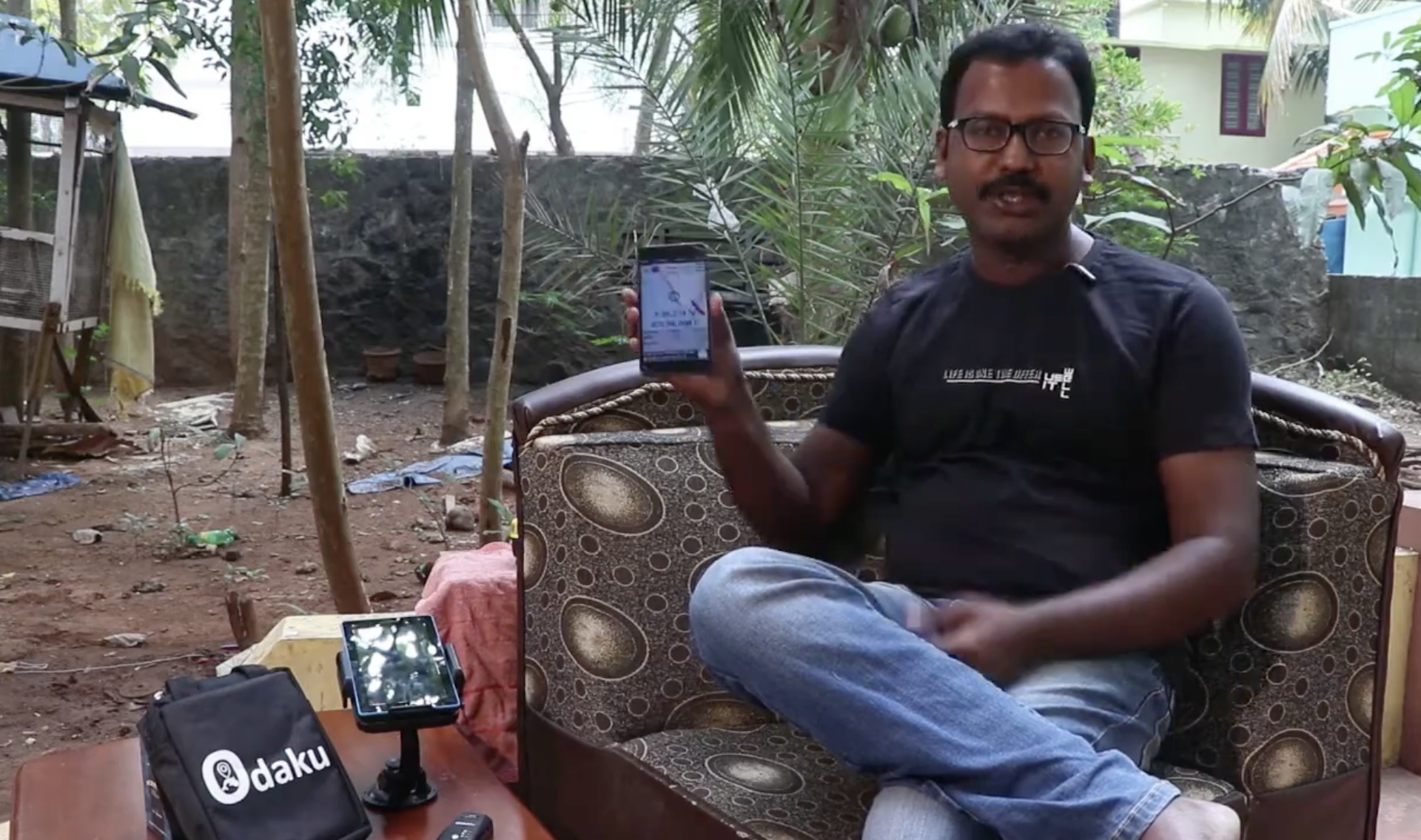
Xavier Lawrance: We provide marine navigation solutions for small-scale fishers. Our Bluetooth GIS Gadget can be connected with an Android-based mobile application to help fishers navigate the environments where they operate and decide which fishing grounds to target. Historically, a fisher would decide where to go based on their experience — knowledge that was difficult to pass down to younger generations. With our platform, fishers can access all the relevant information needed to chart their daily course, including data on weather, bathymetry, and past catches. This fast, reliable data saves fuel costs by reducing the time it takes to find the best fishing spots.
In practice, electronic navigation data is stored offline when fishers are at sea. When they return to shore, that data is transmitted to the cloud, becoming the foundation that bridges a data infrastructure gap in the market. It fills the missing sea-data layer that is missing for seafood traceability, evidence, insurance issuance, and accident verification.
SAFET: One common concern fishers have is related to data privacy. How does Odaku address this?
Xavier Lawrance: Most vessel tracking systems fail because fishers have no control of their own data, which is their biggest concern. Our approach has been to empower fishers with data ownership so that they decide what to share, when to share, and how to share it, whether it’s to settle disputes with companies or to fulfill requests from government authorities.
For example, after a particular shipping accident, the fishers involved decided to share trip data to the shipping company as proof of the accident — and received $50,000 as compensation in return. They owned the data and controlled its use in a way that created real value.
SAFET: Let’s talk more about the system in action. In Kanyakumari, Odaku worked with the Fisheries Department to monitor a fleet of 200+ trawlers. What was actually happening on the water, and how did your system change things?
Xavier Lawrance: For over 20 years, conflict between mechanized trawlers and traditional boats led to accidents and law enforcement issues. Amid declining fish stocks, tensions were only rising. Having already used our navigation solutions first-hand, leaders in the small-scale fishing community approached the Fisheries Department to suggest how these tools could be more widely adopted to restore the peace.
The Department then came to us and explained their pain points in detail. Because we have both technical and domain expertise, we were able to propose a simple but powerful way forward: not separate hardware or software, but a vessel monitoring system that leveraged the same navigation tools the fishers were already using. This was critical given many systems fail due to complicated hardware and cost. When data is controlled by its owners — in this case the fishers — and solutions are built for them, they are far more willing to share it.
With community backing, an online token system was implemented alongside geofencing areas. Fishers must now obtain a token before setting out and submit their navigation data on return. This gives them confidence they are following the rules — and reassurance that if issues arise, authorities can take targeted action against a specific vessel rather than halting all vessels from fishing. It also helps authorities reduce nearshore fishing, limiting the net damage that larger vessels cause traditional fishers.
The result: A 20-year conflict resolved through community engagement, with the community managing cost and implementation itself. The program has now run for six years without external funding, supported entirely by fishers — because it enabled safer deep-sea fishing, created onshore jobs, and improved incomes, all while reducing local conflict. It has also helped fishers claim compensation from ship accidents, share data for catch certification, and build intelligence for future fishing success.
SAFET: What is the link between giving fishers good data and long-term fisheries sustainability?
Xavier Lawrance: Seafood traceability depends on knowing who caught the fish, when, and how — but supply chains often lack this information because fisher participation is low. The key is designing systems that enhance fishers’ incomes rather than simply extracting their data. By connecting exporters directly to fishers, data-sharing becomes mutually beneficial, and also yields rich operational intelligence: fishing effort tracking, catch logs, and more.
SAFET: Where does Odaku go from here?
Xavier Lawrance: Fisheries become sustainable when fishers are genuinely engaged in the solutions. For that engagement to take hold, data must work for fishers economically. Only when the community sees real value does adoption follow, and only then does conservation become lasting.
After years in this space, it’s clear that free solutions that add burden don’t work, while blanket charges have their own drawbacks. There is a third route, where data users pay for access, rather than the cost falling exclusively on the fishers who provide it. Our vision is an integrated platform that puts fishers at the center, where the data they contribute to seafood traceability also works in their favor.
With Odaku’s navigation system, we’re already seeing how powerful community-backed vessel monitoring can be. Those success stories are exactly why the work continues.